Next Generation NCLEX, Clinical Judgment and Nursing Education
Knowing a Concept Is Not the Same as Applying It
A nursing learner may understand a disease process and correctly list its signs and symptoms.
However, when examination questions introduce several patients, changing vital signs, medication orders and competing nursing priorities, the learner must do more than recall information.
The candidate must decide which findings matter, which problems are urgent and what nursing action is most appropriate.
This is the distinction between remembering nursing knowledge and applying that knowledge through clinical judgment.
How Clinical Judgment Works
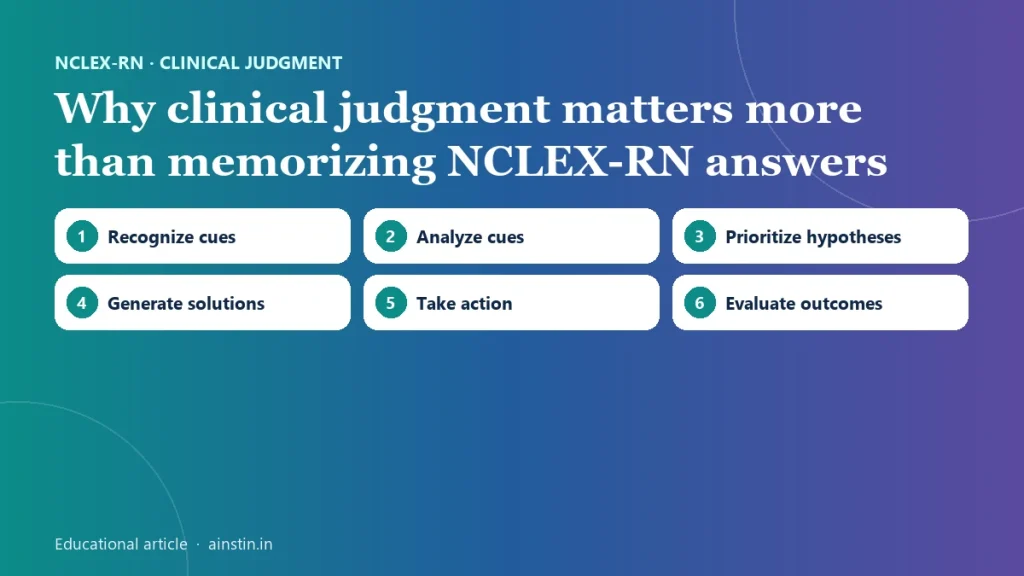
The NCSBN Clinical Judgment Measurement Model describes six related cognitive operations:
• Recognize cues
• Analyze cues
• Prioritize hypotheses
• Generate solutions
• Take action
• Evaluate outcomes
These operations encourage nurses to examine patient information systematically and understand the relationship between assessment, clinical interpretation, action and evaluation.
Example: Understanding Patient Deterioration
Consider an educational scenario involving a hospitalized patient whose respiratory condition is changing.
A learner should not focus only on the diagnosis printed in the clinical history.
The learner must identify which new findings indicate potential deterioration, consider the immediate safety implications and determine the appropriate nursing priority.
The important question is not simply, “What disease does this patient have?”
It is, “What does the available clinical information indicate, and what is the safest appropriate nursing response?”
This reasoning is central to understanding many NCLEX-RN clinical situations.
A Better Method for Studying
Instead of memorizing question answers, learners should:
Review the underlying nursing concept
Identify the relevant assessment findings
Consider the patient's immediate risks
Analyze why one intervention is appropriate
Examine why alternative options may be unsuitable
Review how the patient's response should be evaluated
The aim is to develop a method of clinical reasoning that can be applied to unfamiliar scenarios.
Conclusion
Strong NCLEX-RN preparation combines nursing knowledge with clinical judgment.
Memorization remains useful for essential facts, but examination readiness also requires understanding how those facts influence safe patient care.
Sources and Further Reading
About the Author
Ainstin S Dennis, MSc Nursing (Psychiatric), is Founder & Director of Medline Academy®, Thiruvalla, Kerala.
He began his nursing education career in 2008 and online NCLEX-RN training in 2014.
His principal teaching interests include clinical judgment, psychiatric nursing, medical-surgical nursing, patient safety, prioritization, delegation and concept-based learning.
→ Read Ainstin S Dennis's Biography | Explore His NCLEX-RN Teaching Expertise
Editorial notice: These articles provide general nursing education and examination preparation information. They are not substitutes for professional clinical protocols, regulatory guidance or patient-specific medical decisions.