Mental Health Nursing, Therapeutic Communication and Patient Safety
Psychiatric Nursing Is an Essential Part of General Nursing Practice
Mental health nursing is not limited to specialized psychiatric care settings.
Nurses in medical, surgical, emergency, community and other clinical environments regularly care for patients experiencing anxiety, emotional distress, behavioural changes or mental health disorders.
For this reason, psychosocial assessment, communication and safety are relevant across many areas of nursing.
Therapeutic Communication
Therapeutic communication requires nurses to listen, assess the patient's needs and respond in ways that support safe and professional care.
Students should learn to distinguish therapeutic responses from statements that minimize feelings, make assumptions, offer unsupported reassurance or interfere with effective assessment.
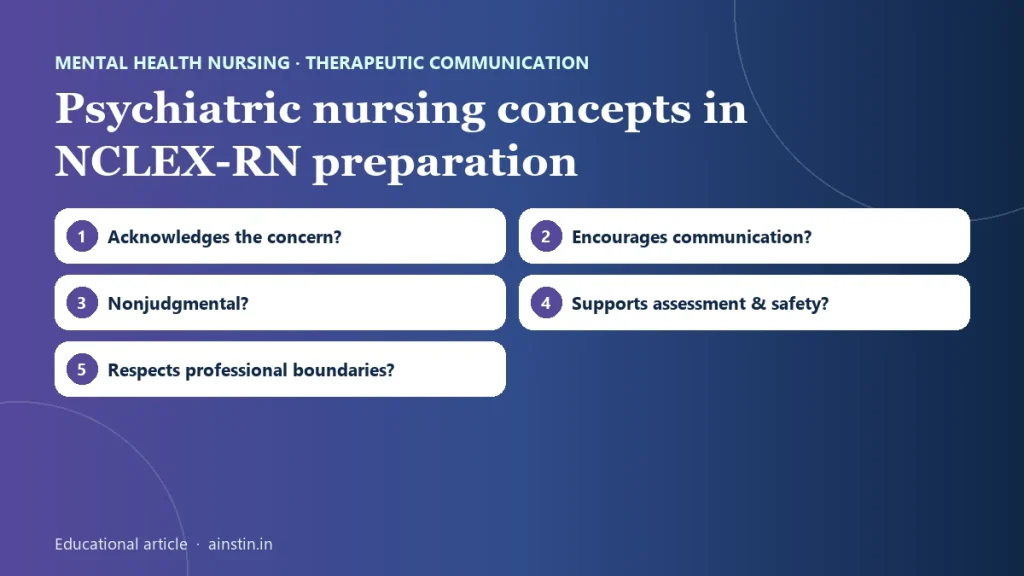
A useful learning method is to ask:
Does the response acknowledge the patient's concern?
Does it encourage appropriate communication?
Is the statement nonjudgmental?
Does it support assessment and patient safety?
Does it respect professional boundaries?
These questions help students evaluate communication options through nursing principles instead of memorizing fixed phrases.
Mental Health and Safety Priorities
Mental health nursing questions may involve risk assessment, behavioural changes, medication monitoring and patients experiencing psychological distress.
In these situations, patient safety and appropriate assessment remain essential.
Learners must understand the clinical scenario, distinguish immediate risks from nonurgent concerns and consider the nurse's responsibilities within the care setting.
Connecting Theory With Clinical Reasoning
A candidate who memorizes the diagnostic features of a psychiatric disorder may still struggle with a question asking what the nurse should assess or do first.
The learner needs to understand how symptoms, patient behaviour, clinical history and safety concerns influence nursing priorities.
This is why psychiatric nursing education should combine conceptual knowledge, communication skills and clinical reasoning.
Conclusion
Psychiatric nursing contributes to the development of safe, compassionate and clinically informed nursing practice.
For NCLEX-RN candidates, mental health preparation should focus on understanding psychosocial needs, therapeutic communication, risk identification and appropriate nursing decisions.
About the author: Ainstin S Dennis holds an MSc Nursing specialization in Psychiatric Nursing and teaches nursing concepts through Medline Academy®.
Sources and Further Reading
About the Author
Ainstin S Dennis, MSc Nursing (Psychiatric), is Founder & Director of Medline Academy®, Thiruvalla, Kerala.
He began his nursing education career in 2008 and online NCLEX-RN training in 2014.
His principal teaching interests include clinical judgment, psychiatric nursing, medical-surgical nursing, patient safety, prioritization, delegation and concept-based learning.
→ Read Ainstin S Dennis's Biography | Explore His NCLEX-RN Teaching Expertise
Editorial notice: These articles provide general nursing education and examination preparation information. They are not substitutes for professional clinical protocols, regulatory guidance or patient-specific medical decisions.