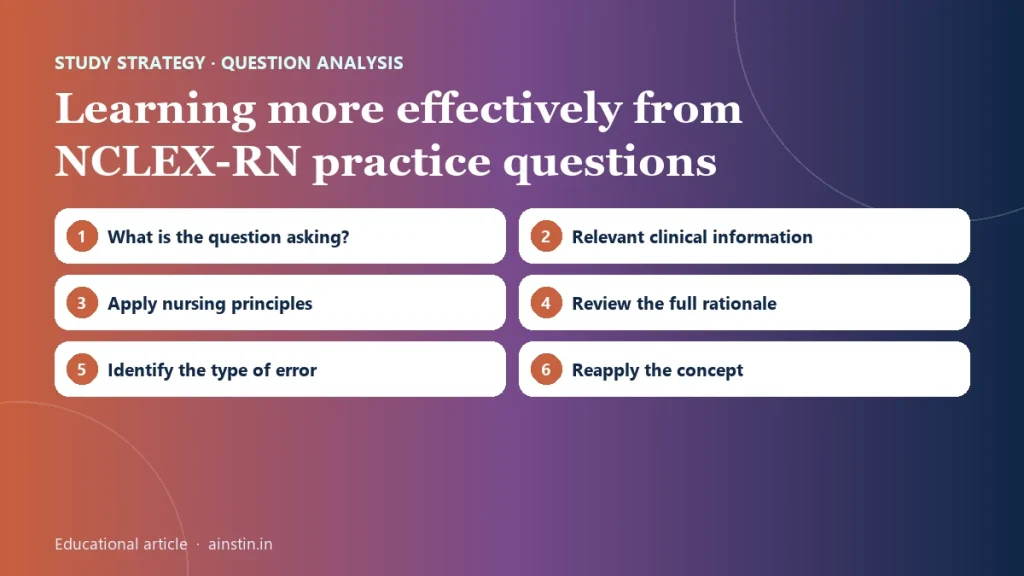
Question Analysis, Study Strategy and Clinical Reasoning
Why Answering More Questions Is Not Always Enough
Practice questions are an important part of NCLEX-RN preparation.
However, completing a large number of questions does not automatically mean that a learner understands the underlying nursing concepts.
A student may recognize familiar wording without being able to apply the same principle to a different patient scenario.
Effective question practice requires a deliberate review process.
Step 1 — Understand What the Question Is Asking
Before choosing an answer, identify whether the question concerns assessment, intervention, prioritization, patient education, delegation or evaluation.
This helps prevent the learner from choosing a generally correct nursing action that does not address the actual question.
Step 2 — Identify the Relevant Clinical Information
Review the patient's presentation, assessment findings, significant risks and changes in condition.
Determine which details influence the nursing decision.
Step 3 — Apply Nursing Principles
Consider the relevant pathophysiology, safety principles, nursing responsibilities and clinical priorities.
Avoid selecting an answer solely because it contains familiar wording.
Step 4 — Review the Full Rationale
After completing the question, study the explanation.
Understand why the correct response fits the scenario and why other options are less appropriate.
The learning value often comes from this analysis rather than from the score itself.
Step 5 — Identify the Type of Error
Not all incorrect answers have the same cause.
An error may result from:
• Incomplete nursing knowledge
• Failure to recognize an important clinical finding
• Incorrect interpretation of the question
• Weak prioritization skills
• Confusion about nursing responsibilities
• Difficulty applying knowledge to a new scenario
Recognizing the reason for an error helps guide further study.
Step 6 — Reapply the Concept
Revisit the topic using another clinical scenario or a differently structured question.
This helps learners determine whether they have understood the principle or merely remembered the previous answer.
Conclusion
The most effective use of a question bank is not simply to complete a high number of questions.
Its value comes from careful reasoning, identification of learning gaps, review of rationales and repeated application of nursing concepts.
A structured approach can make practice more meaningful and support stronger clinical judgment development.
Sources and Further Reading
About the Author
Ainstin S Dennis, MSc Nursing (Psychiatric), is Founder & Director of Medline Academy®, Thiruvalla, Kerala.
He began his nursing education career in 2008 and online NCLEX-RN training in 2014.
His principal teaching interests include clinical judgment, psychiatric nursing, medical-surgical nursing, patient safety, prioritization, delegation and concept-based learning.
→ Read Ainstin S Dennis's Biography | Explore His NCLEX-RN Teaching Expertise
Editorial notice: These articles provide general nursing education and examination preparation information. They are not substitutes for professional clinical protocols, regulatory guidance or patient-specific medical decisions.